
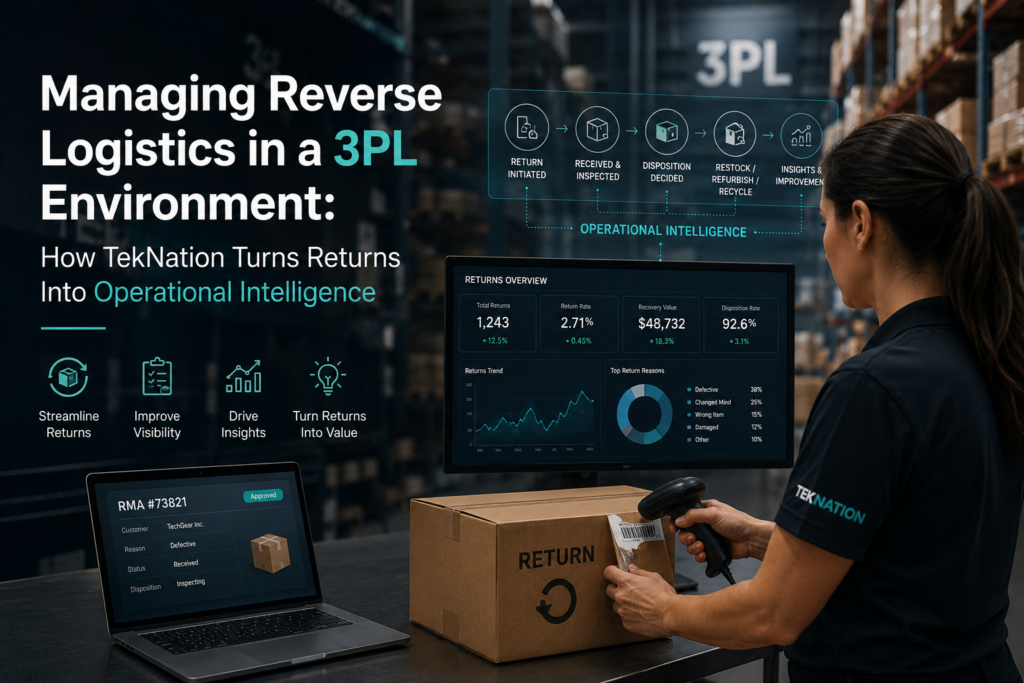
Part of TekNation’s Operational Intelligence Series for 3PL and Logistics Operations
By TekNation
Reverse logistics is the part of the supply chain that most 3PL operators would rather not think about. Outbound fulfillment has a clear rhythm: receive the order, pick it, pack it, ship it. Reverse logistics does not follow that rhythm. Returns arrive unannounced, in varying conditions, requiring different handling for each unit, and demanding a decision about what to do with each one. Left unmanaged, a reverse logistics operation consumes warehouse space, ties up labor, and leaves recoverable value sitting in a receiving dock corner while the accounting team argues with clients over credits they cannot reconcile.
Managing reverse logistics well is not just a cost reduction exercise. For a 3PL operator, it is a client retention strategy. Clients who trust that their returns are being processed accurately, dispositioned correctly, and reported transparently are clients who renew contracts. Clients who cannot get a straight answer about where their returned inventory stands are clients who leave.
TekNation’s operational intelligence platform brings the same real-time visibility, automated alerting, and connected data architecture to reverse logistics that we build for outbound fulfillment, quality management, and production floor operations. This article explains how.
The Five Stages of a 3PL Reverse Logistics Operation
A well-structured 3PL reverse logistics process moves every returned unit through five defined stages, each with its own data requirements, disposition logic, and client reporting implications.
- Return receipt and RMA logging. Every return begins with a Return Merchandise Authorization. The RMA links the physical unit to the original order, the client account, the stated return reason, and the return authorization date. Without a clean RMA log, the downstream process has no anchor. Units arrive without context, get processed inconsistently, and create reconciliation problems that surface weeks later in client billing disputes.
- Inspection and condition grading. Once received, every unit is inspected and graded against a defined condition scale. Grade A units are resalable as new or like-new. Grade B units require refurbishment before resale. Grade C units may be candidates for parts recovery or liquidation. Grade D units are scrap. The grading decision drives everything that follows, and inconsistent grading is one of the most common sources of value leakage in a reverse logistics operation.
- Disposition decision and routing. Based on the condition grade, client disposition rules, and the current market value of the unit, a disposition decision is made: restock, refurbish, return to vendor, liquidate, or scrap. In a well-run operation, this decision follows defined rules rather than ad hoc judgment. TekNation builds the rules-based logic into the data model so disposition decisions are applied consistently and every exception is flagged for review.
- Processing and value recovery. Each disposition path has its own processing requirements. Restock units need relabeling and inventory system updates. Refurb units enter a repair queue with a defined turnaround time. Vendor returns require documentation and chargeback processing. Liquidation units need lot consolidation and buyer coordination. Scrap units need disposal documentation for both regulatory and client reporting purposes.
- Client reporting and credit processing. The final stage is the one clients care about most: a clear, accurate account of what happened to their returned inventory, what credit is owed, and what value was recovered. This report is only as good as the data captured at every preceding stage.
Where the Data Breaks Down and Why It Matters
The five-stage process described above is well understood in the industry. The reason most 3PL reverse logistics operations underperform is not a lack of process knowledge. It is a lack of data connectivity between the stages.
The WMS logs the receipt. The inspection result goes into a spreadsheet. The disposition decision is communicated by email. The refurb queue lives in a separate system. The credit memo is generated manually in accounting. At no point does any one person have a complete, current view of where every returned unit stands across all five stages simultaneously. When a client asks “where are my 47 units returned last Tuesday and what is the credit status?” that question takes hours to answer, not minutes.
TekNation connects those systems. The data model pulls RMA records, inspection grades, disposition decisions, processing status, and credit memo data into a single Power BI environment. Every returned unit is tracked from receipt through final disposition in one view, updated on a short refresh cycle, and accessible to operations managers and account managers without requiring access to multiple backend systems.
The Metrics That Define Reverse Logistics Performance
TekNation builds reverse logistics dashboards around the metrics that drive both operational efficiency and client satisfaction. These are the numbers that belong in every 3PL reverse logistics review meeting:
- Return processing cycle time. The elapsed time from RMA receipt to final disposition decision. A benchmark 3PL operation processes returns within 24 to 48 hours of receipt. Aging returns beyond that window tie up warehouse space and delay client credits.
- Condition grade distribution. The percentage breakdown of Grade A, B, C, and D units across returned inventory. A shift toward Grade C and D over time may indicate a product quality issue, a packaging problem, or a shipping damage pattern that is worth surfacing to the client before it becomes a larger problem.
- Value recovery rate. The percentage of returned inventory value that is recovered through restock, refurb, or liquidation versus written off as scrap. This metric directly measures the financial performance of the reverse logistics operation and is one of the most compelling numbers to show a client in a quarterly review.
- Return rate by SKU and client. The percentage of outbound units that come back as returns, tracked by product and client account. A rising return rate on a specific SKU is an early signal of a product or fulfillment issue. Catching it in the return data before the client raises it in a contract review is the difference between proactive account management and reactive damage control.
- Refurb queue aging. The number of units in the refurbishment queue and how long each has been there. Units that enter the refurb queue and age without movement represent both a capacity problem and a credit delay problem. Power Automate alerts flag refurb queue items that exceed their target turnaround time before they become a client complaint.
How Automated Alerts Change the Response Speed
A static dashboard requires someone to be watching. Power Automate changes that dynamic entirely. TekNation configures alert workflows that trigger automatically when reverse logistics metrics cross defined thresholds.
When a high-value unit is received and graded Grade C or D, the account manager receives an automatic Teams notification so the client conversation can happen proactively rather than reactively. When a return batch from a specific client exceeds the agreed processing cycle time, the operations manager is alerted before the SLA is breached. When the refurb queue for a client account exceeds its target age, the warehouse supervisor receives a flag to reprioritize labor. None of these alerts require someone to remember to check a report.
Client Transparency as a Competitive Differentiator
The 3PL market is competitive and client switching costs have declined as technology has improved. The 3PL operators who retain clients over long contract cycles are the ones who make their clients feel informed and in control. Real-time return visibility is one of the most effective ways to create that feeling.
TekNation builds client-facing reverse logistics dashboards that give account managers a filtered view of each client’s return status. An account manager walking into a client review meeting can show, in real time, how many units were returned last month, what their condition grades were, what happened to each unit, what value was recovered, and what credits are pending. That is a fundamentally different conversation than presenting a PDF summary that the client cannot interrogate.
Clients who can see their data do not have to ask about it. The absence of questions about return status is one of the quietest indicators of a healthy 3PL client relationship.
Getting Started
TekNation begins every reverse logistics engagement with a data source assessment: where RMA data lives, how inspection results are recorded, where disposition decisions are tracked, and what the current client reporting process looks like. In most cases the underlying data exists across two or three systems. The work is connecting it into a single model that powers the dashboard, the alerts, and the client reporting layer simultaneously.
For 3PL operations already running the SAAG board or the executive dashboard framework from earlier in this series, the reverse logistics module integrates into the same data architecture without requiring a separate build.
We are based in Douglasville, GA and serve 3PL and logistics businesses throughout the greater Atlanta area and beyond. Reach out to schedule a reverse logistics data assessment.
TekNation is a Microsoft-focused managed services provider based in Douglasville, GA, serving 3PL, logistics, and manufacturing businesses with 1 to 100 employees. We specialize in Microsoft 365, Power BI, Power Automate, and operational intelligence solutions built for the warehouse and the distribution floor.
Ready to turn your reverse logistics operation into a client retention advantage? Contact TekNation today.